The main criteria for choosing an inverter ended up being how much power my car could generate. With the stock alternator and the stock power draw from the accessories, there is perhaps 400watts extra power that can be taken (just a guess, though most of the required info is in my owner's manual). If more power is needed, there are a number of upgrades required, including a larger alternator and additional batteries, both of which would have a noticable impact on the car's acceleration. I ended up getting a 600 watt inverter just in case I want some room to grow. The power supply on my 1998 computer is 235watts max, and an LCD screen would take about 60 watts max, so the power constraints aren't that limiting.
The next consideration was whether to get a pure-sine or modified-sine inverter. It seemed like a lot of people were successfully running computers on just modified sine wave inverters, and I believe that most consumer-level UPS systems must be modified sine inverters (otherwise their total cost would be much more), so it seems mostly safe to go with a modified sine wave inverter.
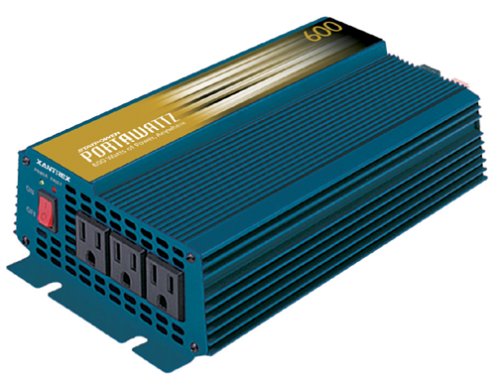
I chose a Statpower/Xantrex Portawattz 600 because there were a couple places that indicated that they were higher quality than the others, and I managed to pick one up for $82 shipped.
I'll try to mount it on the side of my trunk, sorta like these: one, two. Physically attaching the inverter to the trunk can be done the same way as amps do it — their term for this is "amp rack". While I'm at it, I'll want to remember that I'll be installing a computer in there soon too, so if there's a way to provide for mounting points for it as well, that'd be ideal.
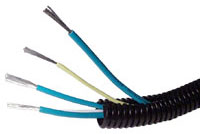
Electrical layout is covered here. Installation is covered here (this is split loom tubing), here, here, here, here, here and especially here. We're running 600watts at 12volts, that's 50amps, which means very large wire and fuses. (for specific recommendations, see this or this). Fortunately for us, there are some applications that we can co-opt equipment from. Car amplifiers, for instance, have the same requirements, so there are various wiring kits available that would work, but translucent wires may or may not be your thing, and the associated 300% markup may or may not be your thing (actually, since the fuse holder + fuse + shipping ended up being ~$20, it may have not been any cheaper to do it myself). A better option is to buy parts from RV or Semi supply places, as those vehicles often have even larger amperage requirements at low voltage. I document my search for the individual wiring components here. Also be very conscious of safety, as we're working with near-mains power, so all safety precautions normally used with electric outlets should be used here. See this, this, this, this book, this. And since risks from water and shield melting are higher, perhaps safety should be even more important.
Power Outlets: It would be awfully nice to have one or two 120v outlets in the passenger compartment. I'm not sure how to do this in a way that looks really nice though. I know that there are some cars that have them (eg. pontiac vibe 2, toyota matrix 2 3), as do RV's, semis, and boats. I could order specific parts from Toyota or Pontiac, or general stuff from vehicle supply stores. In either case, I'll want to be sure to mount them in a place where there's enough room to plug a wall wart in (for example, my cell-phone charger). Also note that since we're trying to be saftey conscious, it would be best to have 3-prong outlets so that the ground-fault interrupters could work properly.
There isn't a trivial way (eg. an existing signal I can use) to control the power to the inverter. The different switching scenarios include: 1.5 seconds after the ignition turns on, the inverter should turn on (the inverter doesn't need to deal with the low voltage while the engine is cranking, and if the user decides to mess around with the ignition, we should insulate things from that); when turning off, the computer should be notified that power is being removed, and the inverter should wait 60 seconds for the computer to power off; the inverter system should automaticaly initiate shut-down when the ignition is turned off; the user should be able to (pre-emptively?) override this automatic shut-down to cause power to remain on while the ignition is off; the user should be able to toggle the inverter on and off, regardless of whether the ignition is on, and if the battery starts getting near a level where it might be hard to start the car (or sooner), the µP should initiate shutdown (though this might be covered by the inverter's low-voltage detection?).
All of this calls for a microcontroller to control it. As far as I can determine, the best way to do control the power output is to hack the inverter's power switch. Depending on how much current is going through it, I may need to hook up whatever size transistor is needed, but eventually I should be able to control it with a TTL level signal. It'd also be nice if I could retain use of the existing power switch in case I want to re-use the inverter.
Items in grey are "todo" items.